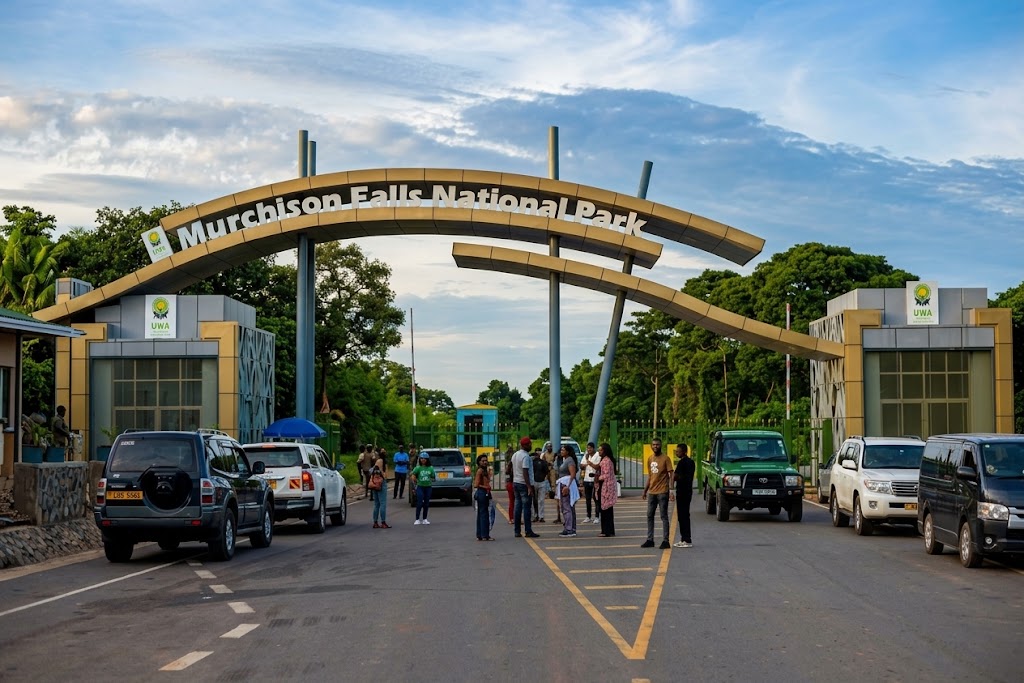
Murchison Falls is Uganda’s largest and most visited national park, and it is one of the easiest parks to reach on your own. A self-drive to Murchison Falls National Park gives you the freedom to set your own pace: your own game drives, your own stops, and no fixed group schedule.
This guide covers the routes from Kampala, the park gates, the ferry across the Nile, what the roads are like, and how to plan your days inside the park.
How Far Is Murchison Falls from Kampala?
The park lies in north-western Uganda. From Kampala the most-used route runs through Masindi and covers roughly 300 km, which takes about 5 to 6 hours including stops. Allow longer in the wet season or if you leave during morning traffic.
Routes and Gates
- Via Masindi to Kichumbanyobo gate. The usual choice. Tarmac through Luweero and Nakasongola to Masindi, then a murram road to the gate. This route brings you in through the Budongo Forest, where chimpanzees are sometimes seen crossing the road.
- Via Masindi to Bugungu gate. A longer, rougher descent along the escarpment with wide views over the Albertine Rift. Best in dry conditions and in a high-clearance vehicle.
- Via Karuma to Tangi or Chobe gate. Tarmac most of the way along the Gulu highway, useful if you are coming from or continuing to northern Uganda.
Fuel up in Masindi or at Karuma. There are no reliable fuel stations inside the park, and lodge fuel, where it exists at all, is expensive.
Stop at Ziwa Rhino Sanctuary on the Way
Ziwa Rhino Sanctuary sits right on the Masindi route, about 170 km from Kampala, and it is the only place in Uganda where you can see wild southern white rhinos. Rhino trekking is done on foot with a ranger and takes two to three hours, so it fits neatly into the drive up.
Most self-drivers stop at Ziwa in the morning, have lunch there, and still reach the park gate in good time. Other worthwhile stops on this route are the Budongo Forest for chimpanzees and the top of the falls on your way out.
The Paraa Ferry
The Nile splits the park in two. Most game drives are on the northern bank, while many lodges and the Masindi gates are on the southern side, so you will probably use the Paraa ferry.
- It runs at set times through the day, so check the current schedule at your gate or lodge and plan around it.
- Arrive early for the crossing you want. Vehicles queue, and the ferry takes a limited number at a time.
- Pay the vehicle fee at the crossing.
- Missing the last ferry of the day means a very long detour by road, so do not cut it fine.
Park Entry and Fees
Entry fees are set by the Uganda Wildlife Authority and depend on your nationality, the number of nights, and your vehicle. Pay at the gate or in advance, and keep your receipt, as it is checked when you move between sections of the park. Fees change from time to time, so confirm the current rates before you travel.
What It Costs
All figures below were correct in October 2026 and are given as a guide only. The Uganda Wildlife Authority and operators can change them at any time and without notice, so confirm current rates before you travel.
- Park entry, foreign non-resident: about US$45 per adult and US$25 per child, valid 24 hours.
- Vehicle entry: about UGX 30,000 per entry for a Uganda-registered car, charged per entry rather than per day.
- Self-guided game drive: about US$10 per person, on top of park entry.
- Guided game drive: about US$25 for a UWA ranger guide for the day, which is money well spent if you want to find lions.
- Boat trip to the base of the falls: about US$30 per person with UWA, and US$40 or more with private operators.
- Delta cruise: roughly US$40 to US$60 per person.
- Paraa ferry: a small vehicle fee is paid at the crossing.
- Ziwa Rhino Sanctuary rhino trekking: about US$50 per person.
What the Roads Are Like Inside the Park
- Park tracks are murram and sand, not tarmac.
- In the dry season most tracks are firm and a high-clearance vehicle handles them easily.
- After rain, black-cotton sections turn slick and sticky, and some tracks become impassable.
- There is no mobile signal in parts of the park, so carry offline maps.
- Driving is allowed between set hours only, and night driving in the park is not permitted.
For more on surfaces you will meet on the way, see Types of Roads in Uganda.

The Best Time to Visit Murchison Falls
The park is open all year, but the dry seasons, December to February and June to September, are the best time for a self-drive. Tracks are firm, grass is short, and animals gather near the Nile, so game viewing is easier and you are far less likely to get stuck.
- December to February: hot and dry, excellent game viewing, busiest over Christmas and New Year.
- June to September: dry and a little cooler, the most popular season, so book lodges early.
- March to May and October to November: the rains. The park is green and quiet, rates are often lower, and birding is at its best, but black-cotton tracks get slippery and a strong 4×4 matters more.
Which Car Do You Need?
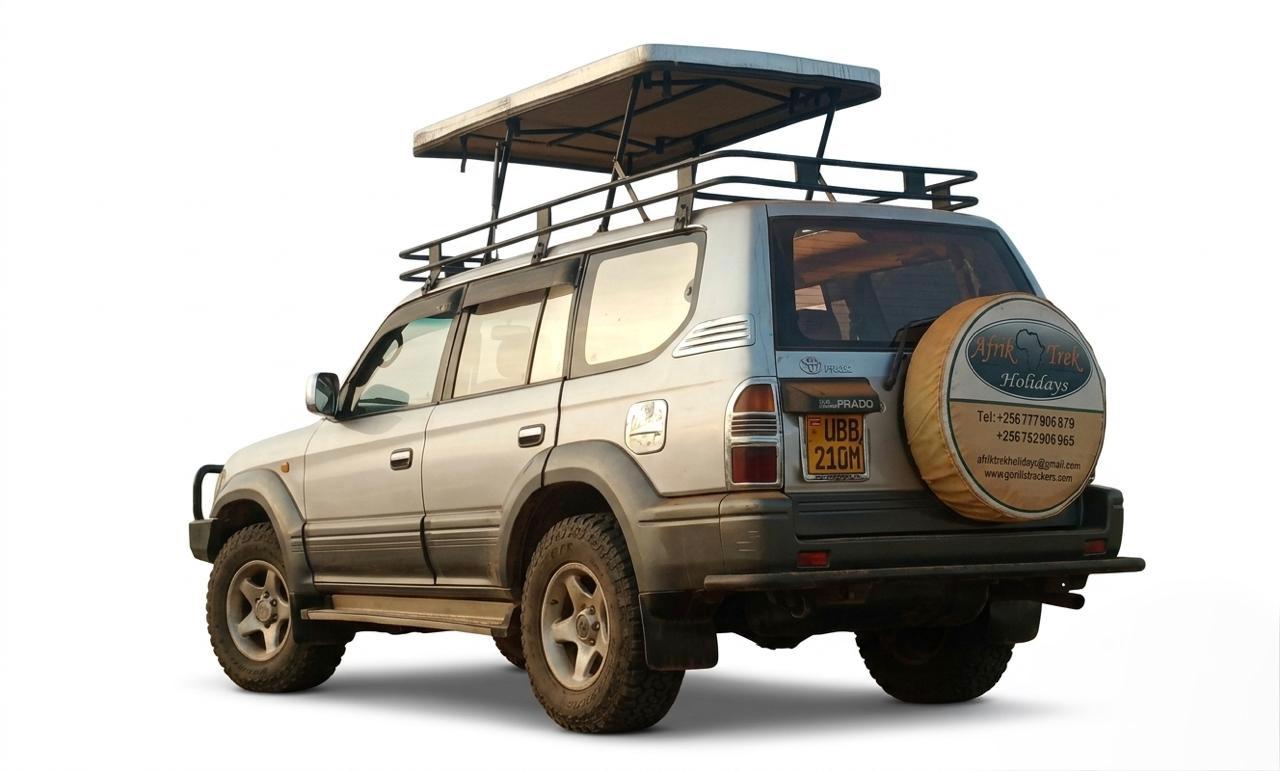
A 4×4 is the sensible choice. A RAV4 is adequate in the dry season on the main tracks and is the budget option. A Land Cruiser Prado or a hard-top with a pop-up roof is better for game viewing, carries more luggage, and copes far better with wet conditions.
- Pop-up roof: lets everyone stand and photograph without leaving the car.
- Ground clearance: matters on the Bugungu descent and after rain.
- Spare wheel and jack: check both before you leave, along with the tyre condition.
- Camping gear: useful if you plan to stay at the park campsites. See Rooftop Tent Camping in Uganda.
Not sure which model suits your trip? Compare options in Best Type of Car to Rent in Uganda.
What to Do in the Park
- Game drives on the northern bank: lions, elephants, giraffes, buffaloes and antelope on the Buligi tracks, best in the early morning.
- Boat trip to the base of the falls: hippos, crocodiles and birds along the way, and the falls head-on at the end.
- The top of the falls: a short walk to where the Nile is forced through a seven-metre gap. You can drive to the car park and hike in.
- Budongo Forest: chimpanzee tracking and forest birding near the southern entrance.
- Delta cruise: a quieter boat trip towards Lake Albert, good for shoebill sightings.
A Simple Three-Day Plan
- Day 1: leave Kampala early, reach the gate by mid-afternoon, and settle into your lodge or campsite.
- Day 2: early game drive on the northern bank, lunch and rest, afternoon boat trip to the base of the falls.
- Day 3: stop at the top of the falls on your way out, then drive back to Kampala, arriving before dark.
For where to stay, see Lodges in Murchison Falls National Park.
Practical Tips
- Book accommodation ahead, especially between June and September and over Christmas.
- Carry cash. Card payment is unreliable at gates and small lodges.
- Start game drives at dawn. Animals are active early and the light is better.
- Keep windows up near animals, and never get out of the car except at designated spots.
- Do not drive after dark on the way home. See Driving at Night in Uganda.
- Know what your cover includes before you go, as explained in Car Rental Insurance in Uganda.
Frequently Asked Questions
Is it easy to self drive in Uganda?
Yes, for a confident driver. The main highways are tarmac and signposted, fuel is easy to find in towns, and you drive on the left. What takes adjusting to is the traffic culture: boda bodas, slow trucks on hills, speed humps that appear without warning, and pedestrians at the roadside. Inside parks the tracks are murram, so a 4×4 is needed. Avoid driving after dark and the rest is straightforward.
How much does it cost to enter Murchison Falls National Park?
About US$45 per adult and US$25 per child for foreign non-residents, valid for 24 hours, plus roughly UGX 30,000 for the vehicle. East African citizens and foreign residents pay less. Rates were correct in October 2026 and can change at any time.
How much is a boat cruise at Murchison Falls?
The launch trip to the base of the falls costs about US$30 per person with the Uganda Wildlife Authority, and US$40 or more with private boats. The delta cruise towards Lake Albert runs around US$40 to US$60 per person. Prices as of October 2026 and subject to change.
What is the main tourist attraction in Murchison Falls National Park?
The falls themselves. The entire Nile is forced through a gap about seven metres wide and drops roughly 43 metres into the gorge below. Most visitors see them twice: from the water on the launch trip, and from above on the short walk at the top of the falls. The other main draw is the game viewing on the northern bank, where lions, elephants, giraffes and buffaloes are regularly seen.
Is Murchison Falls the strongest waterfall in the world?
It is widely described as the most powerful waterfall in the world, because such a large volume of water is squeezed through such a narrow gap. It is not the largest by height or by volume of flow, so treat the claim as a description of its force rather than a record.
Can you swim in Murchison Falls?
No. The Nile here holds large crocodile and hippo populations, and the current above and below the falls is violent. Swimming is not permitted and would be extremely dangerous. Some lodges have swimming pools, which is where to cool off instead.
Is it safe to swim in waterfall water?
Not at Murchison. Beyond the wildlife, waterfall plunge pools carry strong undertows, hidden rocks and sudden flow changes after upstream rain. In Uganda there is also a risk of bilharzia in slow-moving fresh water. Stick to pools at lodges or to places your guide confirms are safe.
What is the best time to visit Murchison Falls National Park?
The dry seasons, December to February and June to September. Tracks are firm, grass is short and wildlife gathers near the river. The wet months are greener and quieter with better birding, but the tracks are harder going.
What is the best car for a self-drive trip to Murchison?
A 4×4. A RAV4 is fine in the dry season on main tracks and is the cheapest option. A Land Cruiser Prado or a hard-top with a pop-up roof is better for game viewing, luggage and wet-season tracks.
How much does a safari in Uganda cost?
A self-drive trip is the cheapest way to do it. Budget roughly US$60 to US$150 a day for the vehicle depending on the model, plus park entry, fuel, and accommodation from about US$30 a night at campsites to US$200 or more at upmarket lodges. A guided safari with a driver and a mid-range lodge typically works out at US$250 to US$400 per person per day. Gorilla permits are a large separate cost. These are estimates for October 2026 and vary by season and operator.
Which self-drive safari in Africa is the best?
It depends on what you want. Namibia and Botswana are the classic self-drive countries for empty landscapes and well-run campsites, and South Africa’s Kruger is the easiest for a first attempt. Uganda stands out for variety: you can combine big-game parks like Murchison with chimpanzees, gorillas and the source of the Nile in one trip, over shorter distances than in southern Africa, and at lower cost.
Hire Your Murchison Falls Self-Drive Car
We rent 4×4 vehicles prepared for park conditions, with unlimited mileage, camping gear on request, and 24/7 support on the road. Collection in Kampala or delivery to Entebbe Airport.
Planning a trip? Contact us on +256 777-906879 or WhatsApp with your travel dates and we will recommend the right vehicle.